

A peculiar profession
I have spent much of my professional life valuing what did not happen. It is, on reflection, a peculiar way to earn a living. One builds careful models of the commercial world as it would have been had certain events not intervened, projects cash flows which by definition never arrived, and then defends the exercise, often for two days in a witness box, against opposing counsel whose purpose is to persuade the tribunal that the picture bears no resemblance to what would have occurred. The humour tends to wear thin somewhere around the middle of the second afternoon.
The profession is, nevertheless, a serious one. Its purpose, at its core, is to assist the court or tribunal in understanding technical questions that lie outside its own expertise, not to advance the case of the instructing party; and the credibility of the profession depends on that distinction being maintained in practice as well as in principle. Its commercial model has held shape for decades and is now being asked questions it has not had to answer for some time. What follows is an attempt to think through them, neither as prediction nor as prescription.
”I have spent much of my professional life valuing what did not happen. It is, on reflection, a peculiar way to earn a living.
The present model
A damages report in a complex dispute requires a substantial apparatus: review of the underlying contract and of the legal framework within which loss is to be assessed, the reading of contemporaneous business documents bearing on the counterfactual, historical financial analysis, market and industry research, scenario modelling, a discounted cash flow or equivalent valuation, and the construction of a counterfactual itself. Each assumption must be transparently justified in a written narrative. Much of the initial work is done by analysts and associates, reviewed by directors, but ultimately supervised, owned and authored by the testifying expert whose name appears on the cover. The price paid reflects, in part, the hours consumed at each layer of that pyramid. The pyramid has served the industry well. It was built, however, for a world in which legwork was expensive and judgement comparatively scarce.
The jagged frontier
The balance between those two costs is shifting. A 2023 field experiment by researchers at Harvard, MIT, Warwick, and Wharton, involving 758 consultants at a major consulting firm, bears on the point. Consultants using one of the current generation of large language models completed their tasks roughly 25 per cent faster and delivered solutions judged to be of significantly improved quality; within the body of the study, that improvement is reported at more than 30 per cent against a control group. Both halves of the skill distribution benefited: those who had scored in the bottom half on a prior assessment task gained about 31 per cent against their own baseline, and those in the top half gained about 11 per cent.
A second finding followed. On tasks lying just outside the model’s competence, consultants using the tool were around 19 percentage points less likely to reach the correct answer than those without it. The authors described the frontier of machine capability as “jagged” rather than smooth, and noted that users who could not see its edges tended to accept authoritative-sounding errors. The implication for a profession whose reports are signed under a duty of independence and defended on oath deserves reflection.
Generation, and verification
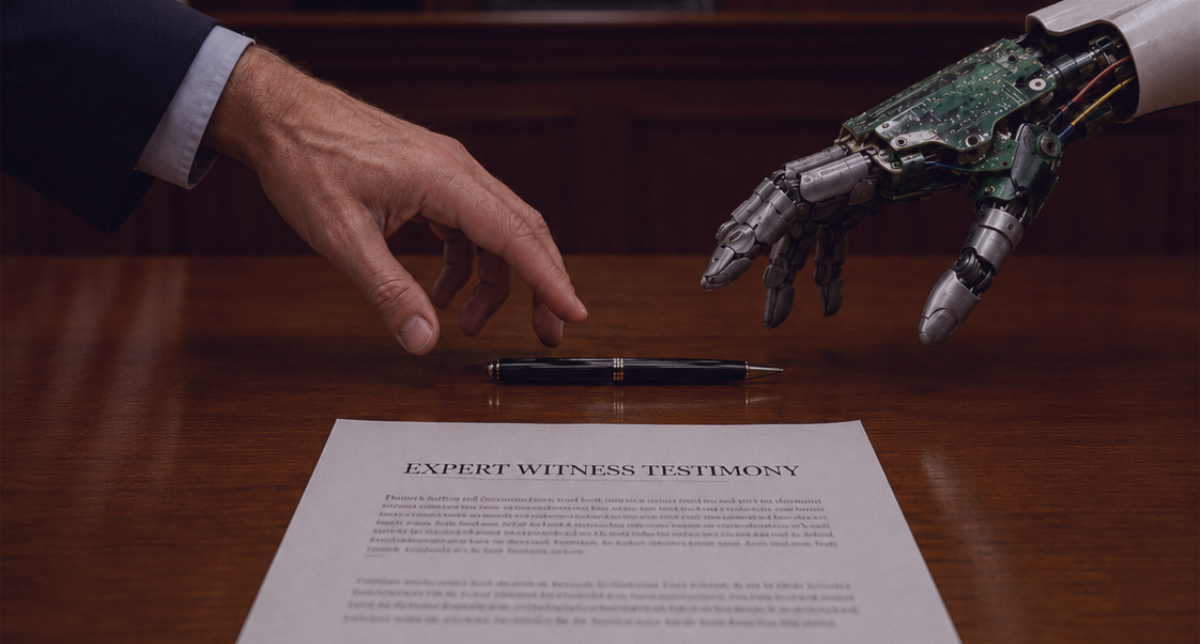
A related point is easily missed. The economics of this change may turn less on the cost of producing a first draft than on the cost of standing behind it. A summary of documents, a first-pass sensitivity analysis, a draft econometric model, a narrative of market background, a list of candidate comparables: these are more easily generated than they were. Whether each figure, source and inference is sound enough for a report which may be tested on oath is a different question, and not one the machine resolves. Hours removed at the front end may reappear, in altered form, at the stages of checking, supervision, and the tracing of provenance. Some of the apparent saving may, in truth, be redistribution.
What is the client paying for?
Suppose that parts of the preparatory and process-driven work behind a damages report become materially faster with the aid of widely available tools. What, precisely, is the client then paying for? Three answers suggest themselves.
First, judgement under genuine uncertainty: the ability to decide, on incomplete information, which of several plausible approaches a court or tribunal is likely to accept, and to explain that choice under adversarial pressure. That judgement rests, in almost every case, on a body of specialist knowledge which the tool does not possess: not the theoretical knowledge, which is by now in its training data, but the practical, applied knowledge that comes of years of using it under professional conditions. This may be functional knowledge of economics, finance, or valuation, or deep sector expertise in, say, pharmaceuticals, oil and gas, or mining, or familiarity with the particular methodologies of specialist disputes such as IP and FRAND, construction claims, or insurance coverage.
Second, the ability to communicate technical analysis with clarity to a tribunal under sustained cross-examination, which is a professional skill in its own right, and one that separates those who understand their work from those who can also explain it.
Third, accountability: the willingness of a human being to stake his or her professional reputation on a conclusion, to answer for it on oath, and to be cross-examined upon it. None of these is automatable in any useful sense. A model cannot stake a reputation, answer on oath, or bear personal accountability for the conclusions it produces. One may therefore see greater differentiation between engagements in which the identity and judgement of the expert remain central, and those in which technology places more visible pressure on process, pricing, or both.
If both sides use the same tools
A further question, less often posed, is this. If experts on both sides have access to broadly similar tools, might their reports not converge? The inefficient positions would, in theory, be filtered out on each side.
Chess is the obvious comparator. When two engines of similar capability meet, draws predominate, because chess possesses a determinate ground truth. A damages case does not. The question of what would have happened absent some act or omission is, by definition, one on which no single right answer exists; and where reasonable experts disagree, that disagreement is itself useful to the tribunal in mapping the range of possible outcomes and their financial consequences. Reasonable professionals may differ on discount rates, on comparable sets, on the length of a counterfactual period, or on the treatment of tax; and those differences are, at their best, the exercise of professional judgement on matters the tribunal is asked to decide. Similarly capable assistance may therefore not narrow disagreement but relocate it. What remains is the assumption stack, sharper and more concentrated than before, and less susceptible to compromise.
”Hours removed at the front end may reappear, in altered form, at the stages of checking, supervision, and the tracing of provenance.
Bias, old and new
Expert evidence has long been alive to bias in its partisan sense. The duty to avoid such bias, variously expressed in different jurisdictions (the Ikarian Reefer principles being the familiar English formulation), is foundational to the expert’s role. Machine assistance introduces a subtler kind, or perhaps several at once, for which the vocabulary of the courts is catching up.
Training data carries within it the distribution of cases, industries, and analytical approaches upon which the model was built. A confident first draft introduces the risk of cognitive anchoring: one sees the model’s answer before forming one’s own, and finds it disproportionately difficult to set aside. If many experts rely on a small number of similar tools, they may share not only strengths but blind spots. What emerges can have the appearance of consensus without its substance.
One objection, commonly offered, is that machine assistance reduces rather than introduces bias, by removing the subjectivities of the individual human analyst. The difficulty with that objection is that it assumes the bias is visible. The more serious risk is structural: embedded in training data, in model design, or in the expert’s unexamined reliance on outputs whose reasoning cannot be reconstructed under cross-examination. That is not a risk the profession has yet developed the tools to manage.
The old question, whether the expert is shading analysis in favour of the instructing party, remains. A newer one sits beside it: whether the tools are shaping analysis in ways invisible to the expert, to counsel, and to the tribunal alike. None of this is purely hypothetical. The courts have begun to record the consequences.
The record so far
The courts have not waited for the rules to catch up. Since 2023, a steadily lengthening line of reported cases, mostly American but with similar incidents now appearing elsewhere, has dealt with counsel submitting filings that cited authorities which, on inspection, proved not to exist. The sanctions began modestly and have grown. In at least one recent matter, counsel were disqualified from representing their client for the remainder of the case.
More soberingly for those in my line of work, the pattern has reached the expert witness. In Matter of Weber, a New York Surrogate’s Court found the testimony of an expert retained on damages to be unreliable after he acknowledged using a generative AI tool to cross-check his calculations without being able to explain what he had asked it, what sources it had drawn on, or how it had reached its figures. The court went further and held, as a matter of first impression, that counsel have an affirmative duty to disclose the use of artificial intelligence in generating evidence, with such evidence to be subject to a Frye hearing (the American evidentiary test for admitting novel scientific or technical evidence) before admission. In Kohls v Ellison, decided a few months later, a federal court in Minnesota excluded the declaration of a prominent American academic after citations in his report, generated by a large language model, were shown to refer to articles that did not exist. The judge was careful to distinguish responsible use of such tools, which need not be faulted, from unexamined reliance upon them, which may undermine the very independence and critical thinking that expert evidence is supposed to embody. The irony was not entirely lost: the expert in question specialised in misinformation.
The lesson is not that these tools cannot be used. It is that the duty of verification sits with the person who signs the report, and extends to the factual and documentary material on which it relies. That duty cannot be delegated to the machine which produced the draft, and will not be transferred to it by any rule one can presently foresee.
An analogy to the “supervised associate” is sometimes offered: experts have always relied on others to build the models they sign off on. The analogy fails at the point that matters. An associate’s work can be questioned, corrected, and made the expert’s own; a machine’s cannot, because the machine cannot explain its reasoning, exercise judgement under instruction, or be held accountable for what it produces. The duty that the expert owes to the tribunal is personal and non-transferable. It does not travel with the tool.

”A model cannot stake a reputation, answer on oath, or bear personal accountability for the conclusions it produces.
Courts, tribunals, and the emerging rules
The adoption of these tools will not proceed at a uniform pace across forums. Arbitral tribunals can, with the parties’ agreement, adopt procedural protocols within a single case. Courts must wait for rule committees, practice directions, or appellate guidance. In England and Wales, Part 35 of the Civil Procedure Rules and the Ikarian Reefer principles impose an overriding duty to the court and a requirement of independent and uninfluenced opinion. Those principles do not, on their face, address the situation in which material parts of the analysis have been produced with machine assistance.
A useful distinction, borrowed from the emerging economic literature, is between augmentation, where expert and machine work together and the expert remains demonstrably the author, and automation, where the machine produces the substance and the expert adds little more than a signature. Courts are likely to treat the two differently. The first, in moderation, will probably be permitted and in time expected. The second is unlikely to be, and ought not to be.
A deeper question sits close behind. If two opposing experts use broadly similar tools, drawing on overlapping training data and comparable prompts, courts and tribunals may in time ask in what sense each report remains the independent work of the expert whose name appears on the cover. A model is not a co-author in any conventional sense; nor is it quite a spreadsheet. Procedural rules on disclosure of tools and degree of reliance are foreseeable, with closer attention paid to whether the expert’s reasoning remains demonstrably his or her own.
Institutions are, meanwhile, beginning to move. The American Arbitration Association – International Centre for Dispute, through its International Centre for Dispute Resolution, has since November 2025 made available documents-only construction arbitrations in which an AI tool, trained on past awards and operating under human-in-the-loop supervision, produces the draft award which a human arbitrator then reviews, revises, and issues. The scheme is, for the present, narrowly confined to two-party cases, documents-only, with no live evidence. The institution has nevertheless signalled its intention to extend the scheme to further sectors and to higher-value claims.
Other bodies in the arbitration community have moved in a similar direction. The Silicon Valley Arbitration & Mediation Center (SVAMC) published guidelines on the use of AI in arbitration in April 2024, and the Chartered Institute of Arbitrators (Ciarb) followed in March 2025. The International Bar Association Rules on the Taking of Evidence in International Arbitration remain the principal procedural framework but do not yet address the question directly. The IBA’s wider work on artificial intelligence and the legal profession may in time inform guidance on the taking of evidence specifically.
Within the court system, a comparable response is beginning to take shape. In England and Wales, the Civil Justice Council’s consultation on the use of AI in preparing court documents, which includes expert evidence among the categories it addresses, closed on 14 April 2026 with proposals that experts be required to identify the tools used and explain what use has been made of them.
Confidentiality and control
There is, besides, the question of control. Expert work proceeds on pleadings, draft submissions, confidential financial material, board papers, and transaction documents, much of which is subject to privilege or to practical restrictions on circulation. Machine assistance in such a setting raises questions not only of accuracy but of governance: where the data goes, on what terms it is processed, whether it is retained, and what record of its use exists. These are not merely technical points; they bear on the conditions under which clients are prepared to trust the process at all. Adoption in disputes may therefore proceed more cautiously, and on narrower rails, than in other parts of professional life.
A further difficulty arises where the parties do not adopt the same position on machine use. Suppose one party instructs its expert not to place client material on any AI platform, while the opposing expert, acting under a different arrangement, uses such a tool in reviewing the report once exchanged. The question is not merely whether this is prudent. It is whether, and to what extent, an expert owes obligations, if any, to the opposing party in the handling of material which, though disclosed for the purposes of the proceedings, may remain confidential in character and restricted in its permitted use. How such issues are to be analysed, whether by reference to procedural orders, confidentiality undertakings, expert duties, or some combination of all three, remains to be seen. It is not difficult to imagine tribunals and courts being asked to intervene on questions of this kind sooner rather than later.
Emerging guidance has begun to address this. The CIArb Guideline, for example, contemplates that parties, witnesses, and experts may be required to disclose their use of AI tools, with disclosure obligations balanced against duties of confidentiality and the availability of model procedural orders dealing with high-risk uses.
”The lesson is not that these tools cannot be used. It is that the duty of verification sits with the person who signs the report, and extends to the factual and documentary material on which it relies.
The pipeline, and the next generation
A harder question is how the profession preserves its apprenticeship if work traditionally done at junior levels becomes progressively easier to automate. One response, rather than resisting the change, is to think carefully about which elements of training are essential to professional formation and which are largely procedural.
A related question, less comfortable to ask in mixed company, is whether seniority now carries a premium it did not carry before. If a machine can produce a competent first draft on many of the technical questions a junior once learned by doing, through what does the testifying expert principally distinguish himself or herself? The candidates are familiar enough: forensic judgement, courtroom composure, reputational standing, and the ability to explain a conclusion under sustained challenge. Those are attributes which tend to be acquired over years of instructions, meetings with counsel, and time in the box. Seniority has never been a formal qualification in this field, though it has not always been a commercial disadvantage either. Whether these changes strengthen that position further is a question on which one hesitates, understandably, to hold forth. It does not follow that the future belongs only to the seasoned; tribunals have on occasion found reasons of their own to prefer the younger mind over the grander name. It may, however, mean that the route by which the next generation earns equivalent authority becomes less obvious, and perhaps more difficult, than it has been.
That has implications for the universities too. The most common route into this profession has for some decades run through accountancy, finance, or economics at a quantitative end. That remains necessary; it may no longer be sufficient. The premium may, in time, fall on those who combine quantitative training with something less automatable: the structure of argument, the philosophy of evidence, the written and oral communication suited to the witness box, or genuine expertise in a particular industry.
The question turned the other way
”The old question, whether the expert is shading analysis in favour of the instructing party, remains. A newer one sits beside it: whether the tools are shaping analysis in ways invisible to the expert, to counsel, and to the tribunal alike.
Much of the present discussion proceeds on the footing that using these tools may expose the expert to criticism. That may prove correct. It is not, however, the only possibility. If certain forms of machine-assisted checking, summarising, or pattern identification become sufficiently common and reliable within their proper domain, parties may in due course begin to ask why they were not used. The issue would then cease to be whether use is permissible, and become, more awkwardly, what reasonable professional competence requires. That question is not yet ripe, but it is visible on the horizon.
Open questions
The “jagged frontier” described earlier is the better image with which to close. Within its bounds, machine assistance can materially improve the quality of expert work; beyond them, it produces authoritative-sounding errors that a careful professional will not accept. The question worth asking is therefore not whether these tools will be used in damages work, but in what form, to what extent, and under what guardrails. One guardrail is emerging more clearly than the others. Across the American cases, the SVAMC Guidelines, the CIArb Guideline, and the CJC consultation, the common thread is disclosure: disclosure of the tool used, the manner of its use, and the scope of reliance placed upon its output. The expert is likely, in due course, to be required to account for these things, whether by professional duty, by procedural rule, or both. Experience of how comparable tools have spread in other professional settings, together with the evidence of the field experiment cited earlier, points in the direction of adoption. That has implications for the standard of care, for what reasonable professional competence will in time come to require, and for the differentiation of practice.
First, the commercial model. Will it survive if the hours on which it is founded are steadily withdrawn? Will fee structures shift towards subscriptions or fixed quanta? And if the shift extends further, where would that leave the question of independence?
Second, the expert of the future. Will the expert witness of 2035 be the figure one would recognise today, better equipped, or will the role itself have been reshaped?
Third, the shape of the market. Does machine assistance favour smaller firms, by lowering the cost of technical labour and rewarding speed of adaptation, or does it strengthen larger platforms, by increasing the value of supervision, specialist depth, and institutional control over quality? The answer is unlikely to be uniform, and still less reducible to a slogan.
Once the tools are widely available, speed becomes easier to imitate. What remains harder to replicate is the ability to sign a report, defend it under challenge, and support it with supervision, specialist depth, and institutional discipline. The likelier outcome is not a simple victory for one model over another but a sharper segmentation of the market: smaller firms doing well in narrower and more standardised matters, larger platforms retaining an advantage where scale, complexity and reputational risk are greatest. The tribunal of the market, notoriously unsentimental, will in due course sort the question out.
All of this proceeds on the assumption that the human expert remains central. Were that assumption to fall away, the competition would no longer be chiefly between experts or firms but between platforms, data, and the institutions prepared to accept them. That would be a different market altogether, and one in which the present analysis might have only a limited shelf life.
Fourth, the longer-range possibility. Some of those who have thought about this longest suggest that the professions themselves, not merely the work within them, may in due course be disintermediated: expertise which once reached the public only through qualified advisers becomes available directly. Whether that world arrives for the damages expert in ten years or in thirty, or at all in a form those thinkers would recognise, is beyond me to say. It is worth knowing the argument exists.
Finally. It is, I should perhaps acknowledge, a slightly curious exercise for an expert witness to write at any length about the possible disruption of his own trade. Any cross-examiner who troubles to locate this essay in ten years’ time will, I trust, at least allow that one saw the question coming. The lawyers who instruct us, and the tribunals before whom we appear, are not strangers to the same considerations in their own professions. The billable hour, after all, was not invented in my corner of the market. If this piece provokes thought, or indeed disagreement, from either quarter, I should be glad to hear it. The better thinking about an unsettled question tends, in my experience, to come from those who also find themselves sitting in the carriage.
A note in closing
The foregoing has been prepared for the purpose of public contribution to the discussion and debate about how artificial intelligence is likely to affect the profession of the damages expert. It does not constitute professional advice, is not intended to be relied upon as such, and is not to be taken as the view of any firm or institution with which the author is associated. The subject moves quickly; observations which are accurate at the time of writing may not remain so for long, and the author accepts no responsibility for such obsolescence as this piece may shortly acquire.